Collective Learning
We present a comprehensive suite of training designed to facilitate excellence and sustained growth.
Click on the icons


2026 FRM Part 1 - 20 hours of core subjects and questions
The FRM exam is highly regarded because it tests key concepts and fundamental understanding, not just memory and maths. This course is aimed at strengthening your preparation for the FRM Part I examination through 320 core subject questions and 680 multiple-choice practice questions covering the programme’s four core subject areas: • Foundations • Quantitative • Markets and Products • Models and Valuation
2026 FRM Part 2 - 50 hours of core subjects and questions
This course is aimed at strengthening your preparation for the FRM Part 2 examination through 480 core subject questions and 1020 multiple-choice practice questions covering the programme’s six core subject areas: • Credit • Current topics • Treasury & Liquidity • Market Risk • Operations • Risk and investments
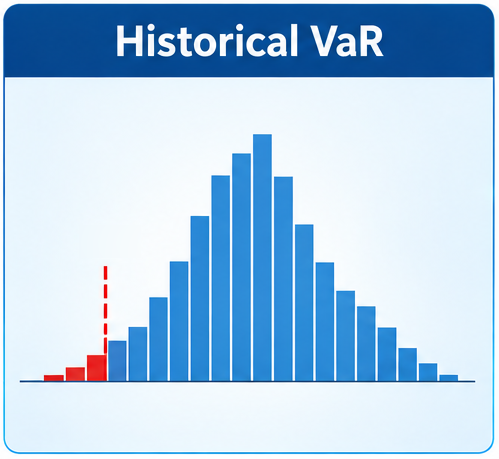
Historical delta 1 VAR
Applies historical return scenarios to today’s portfolio and estimates VaR from the resulting distribution of gains and losses. Each historical scenario receives equal probability, without assuming that returns follow a normal distribution. The course will be available shortly. Contact us directly to purchase your own copy in either Excel or Python.
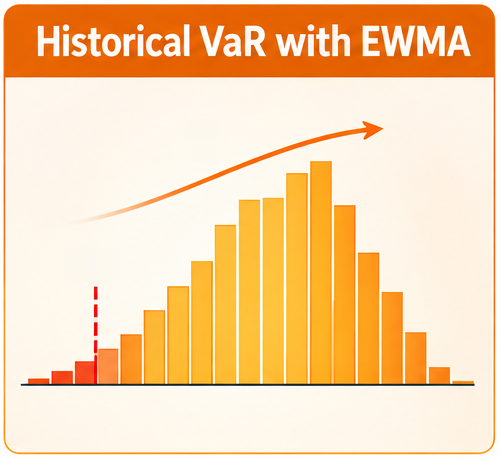
Historical delta 1 VAR with EWMA
Uses historical return scenarios but assigns greater probability to recent observations through exponentially declining weights.
Calculates VaR from the weighted loss distribution, with lambda controlling how quickly older observations lose influence. The course will be available shortly. Contact us directly to purchase your own copy in either Excel or Python.
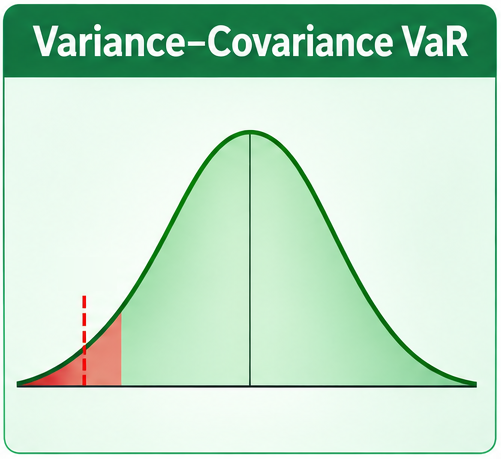
Variance-Covariance delta 1 VAR
Uses asset exposures and an equally weighted historical covariance matrix to calculate portfolio volatility. Converts this volatility into VaR at the selected confidence level, assuming normally distributed portfolio gains and losses. The course will be available shortly. Contact us directly to purchase your own copy in either Excel or Python.
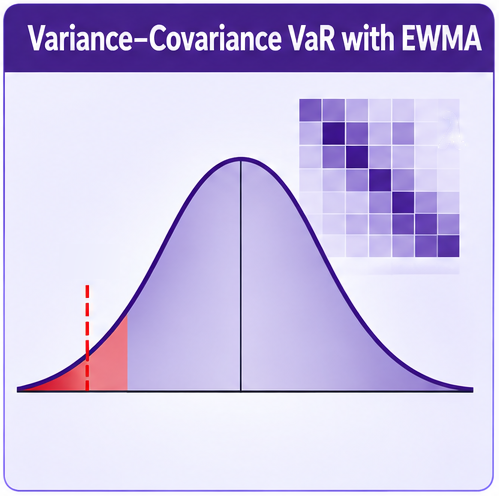
Variance-Covariance delta 1 VAR with EWMA
Uses an exponentially weighted covariance matrix, giving recent observations greater influence over estimated volatilities and correlations.
Calculates VaR under the normal-distribution assumption, allowing the risk estimate to respond to changing market conditions. The course will be available shortly. Contact us directly to purchase your own copy in either Excel or Python.
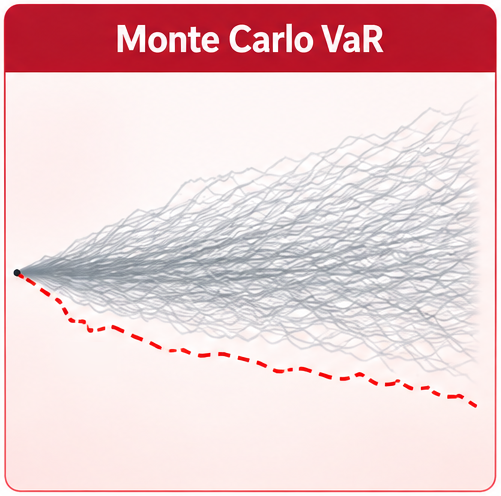
Monte Carlo delta 1 VAR
Generates many correlated random return scenarios and estimates VaR from the resulting simulated portfolio-loss distribution.
This course’s model uses normally distributed returns and a covariance matrix estimated from equally weighted historical observations. The course will be available shortly. Contact us directly to purchase your own copy in either Excel or Python.
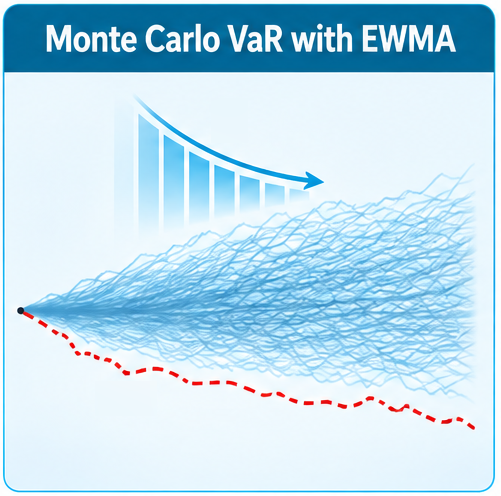
Monte Carlo delta 1 VAR with EWMA
Generates correlated random return scenarios using an exponentially weighted covariance matrix, then estimates VaR from simulated portfolio losses. Recent historical observations receive greater weight when estimating covariance, while the simulated scenarios themselves remain equally probable. The course will be available shortly. Contact us directly to purchase your own copy in either Excel or Python.